InsectoBox Studio
Centre de Recherche Entomologique InsectoBox (CREIB)
BSF Smart Breeding

Black soldier fly farming, driven by AI

InsectoBox Studio is an integrated breeding and bioconversion station for Hermetia illucens: reproduction, pupation and biowaste conversion combined in a 1 m³ Box, with connected monitoring planned.

3
modules
4
circuits
24/7
AI monitoring

InsectoBox — the three elements

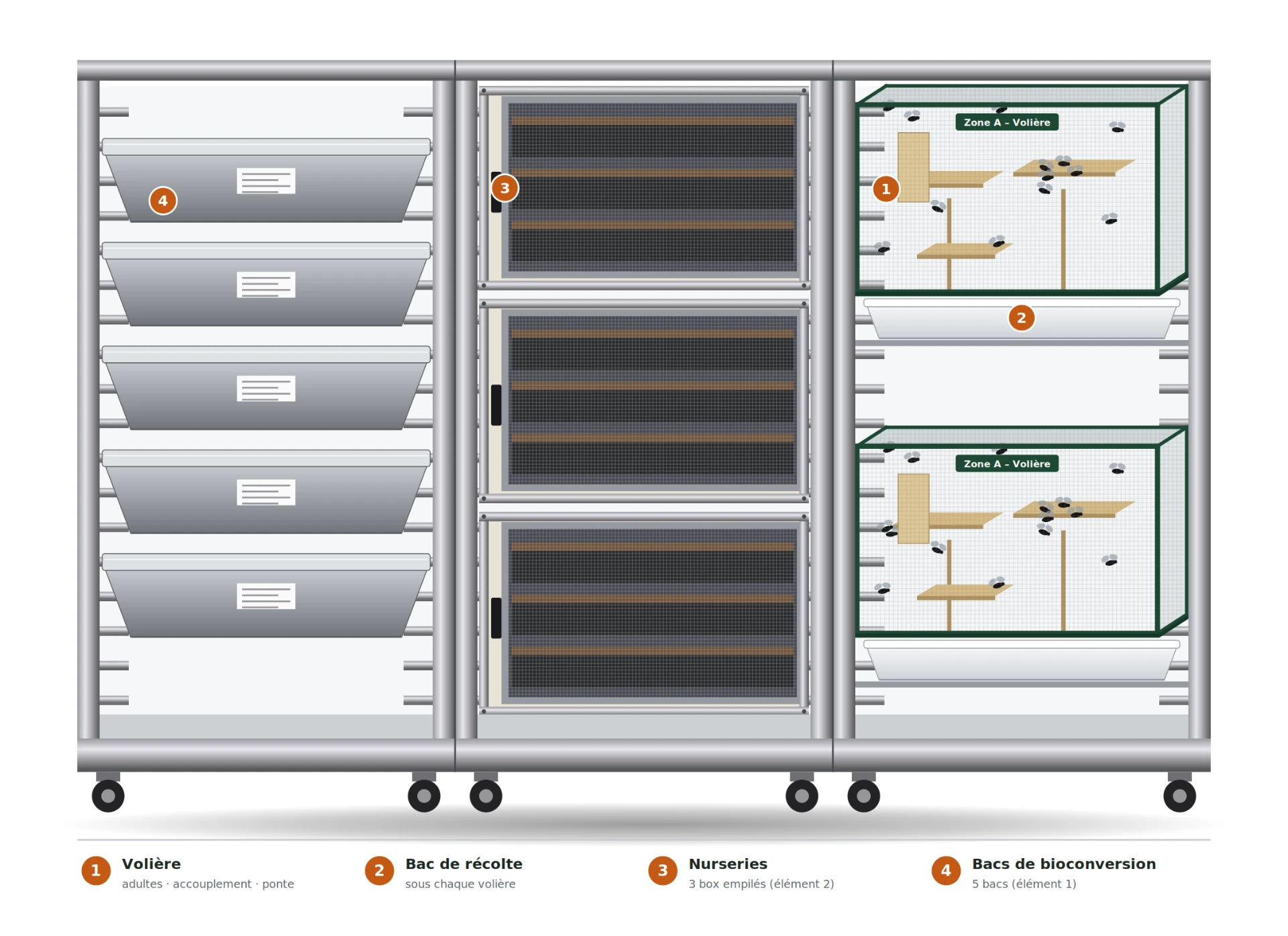
InsectoBox aviaries, collection trays, nurseries and bioconversion trays

Our approach

Turning a good idea into a well-controlled farm

Black soldier fly farming, finally designed as a complete system.

The black soldier fly (Hermetia illucens), also known as BSF, is a promising solution for upcycling authorised organic matter and producing larvae for animal feed, in compliance with applicable regulations.

Its larvae grow quickly in suitable conditions, upcycle certain substrates and can be a valuable source of proteins and lipids. Yet despite these advantages, many breeders struggle to set up a self-sustaining, steady and easy-to-manage farm.

The problem isn’t just raising larvae. It’s mastering the entire production cycle, from adult reproduction to harvest.

That is precisely the challenge addressed by the Insecto-Box Studio – BSF Farm concept.

Why is black soldier fly farming still difficult?

1

Mastering reproduction

Obtaining larvae is relatively simple with a suitable supply. Producing your own eggs and continuously renewing your colony, however, is more complex. Adults need the right conditions to mate and lay eggs: flight space, suitable lighting, proper temperature and humidity, and correctly positioned egg-laying supports.

The Insecto-Box answer

An upper chamber dedicated to adult flies, fitted with a mesh enclosure, lighting and egg-laying supports. This separation allows the reproduction phase to be organised independently of the larval growth phase.

2

Separating the stages of the cycle

In many home-made setups, eggs, young larvae, growing larvae and adults are managed in separate bins, but transfers remain manual and sometimes hard to organise. This repeated handling can cause losses, complicate tracking of generations and increase working time.

The Insecto-Box answer

A modular architecture combining a breeding chamber, a larval development zone and a collection area. The principle is to ease transfers between stages and make the operation of the farm easier to follow.

3

Avoiding excess moisture and liquid build-up

An overly wet substrate, insufficient drainage or a build-up of liquid residues can disrupt larval development and make cleaning harder.

The Insecto-Box answer

A design integrating a bioconversion tank, sloped surfaces and collection outlets. The system is meant to ease the removal of material and liquids into dedicated containers, subject to validation of sizing and watertightness.

4

Harvesting larvae without extra handling

Collecting larvae is a repetitive task. With a poorly designed setup, you have to empty bins, sort material and handle the substrate directly. This takes time and makes harvesting less practical.

The Insecto-Box answer

A bioconversion tank combined with exit points and collection bins. This layout aims to simplify collection and limit direct handling. The level of automation and harvest yield will have to be confirmed by prototype trials.

5

Maintaining suitable rearing conditions

Temperature, humidity, ventilation, lighting and larval density all affect results. In Belgium, seasonal variations make controlling rearing conditions particularly important.

The Insecto-Box answer

A structure enclosed by panels and meshes suited to each zone, designed to organise the space and ease the possible integration of sensors and climate control. Lighting in the adult chamber and larval development conditions must be managed according to their specific needs.

6

Limiting pests and improving hygiene

An open or hard-to-clean setup can let in unwanted insects, attract pests and complicate batch separation.

The Insecto-Box answer

Separate compartments, maintenance access points and clearly identified collection zones. This design aims to improve control of the farm, but must be complemented by procedures for cleaning, disinfection when needed, entry control and substrate management.

One architecture, several complementary functions

Insecto-Box Studio follows a simple logic: organising all farming functions in one coherent piece of equipment.

Adult chamber

House the flies, encourage reproduction and allow egg-laying.

Egg-laying supports

Make egg collection easier.

Development zone

Organise the move of young larvae to their growth phase.

Bioconversion tank

Hold the authorised substrate and support larval development.

Collection system

Ease larva collection and material removal.

Modular structure

Give access to compartments and allow several units to be assembled side by side.

The goal is to move from a collection of separate bins to a structured, scalable farming system that is easier to operate.

A solution designed to grow

The Insecto-Box Studio concept can be considered at different scales: from a pilot farm to an installation with several units in a row.

Assembling five Boxes, for example, would make it possible to study an organisation in independent modules, compare different rearing parameters and ease maintenance without necessarily stopping the whole installation.

Eventually, adding temperature and humidity sensors, cycle tracking, level monitoring and alerts could turn the system into a connected farm.

This evolution will have to be developed and validated step by step, based on results from the prototype.

Our ambition: making BSF farming more accessible

Insecto-Box Studio – BSF Farm aims to simplify the operations that currently make black soldier fly farming hard to organise day to day. Our approach rests on four priorities:

Separate

the stages of the biological cycle.

Simplify

handling, collection and maintenance.

Control

rearing conditions and hygiene.

Modularise

the installation to support its growth.

The ambition is not to promise fully automatic production without human input, but to design equipment that makes the breeder’s work easier and supports progress towards steadier production.

Insecto-Box Studio: from reproduction to harvest, a new way to design black soldier fly farming.

A technical concept under development, to be validated through operation, production, hygiene and durability trials.

Concept & Station

Three modules, one closed ecosystem

A compact aluminium-profile architecture that organises the entire black soldier fly life cycle.

From a BSF rearing bin to a black soldier fly farming kit, equipment choices depend on each stage of the cycle. The InsectoBox concept combines BSF larval incubator and larval harvesting system functions, with automated BSF farming as an objective to be validated on a prototype.

Module A

Breeding aviary

  • LED lighting
  • Water feeders
  • Egg-laying strips
  • Transfer mesh for hatched larvae

Module B

Dark chamber — pupation / emergence

  • Opaque walls
  • Migration ramp for mature larvae
  • Adult exit to the aviary

Module C

Bioconversion tank

  • Organic substrate
  • Larval growth
  • Sloped bottom
  • Separated outputs

Full technical drawing

Conceptual plan — dimensions to be validated before manufacturing1000 × 1000 × 1000 mm

How it works

The 4 functional circuits

Larval, liquid and solid flows: every output has its own path.

1

Biological cycle — Larvae / Adults

  1. Larvae→
  2. Dark chamber→
  3. Pupation→
  4. Emergence→
  5. Aviary→
  6. Egg-laying→
  7. Larvae
2

Larva harvest circuit

  1. Mature larvae→
  2. Ramp→
  3. Removable harvest bin
3

Liquid drainage circuit

  1. Sloped bottom→
  2. Solids filter→
  3. Valve→
  4. Collection bucket
4

Solid residue circuit (frass)

  1. Service outlet→
  2. Removal of residual substrate & frass→
  3. N-P-K agronomic use

Artificial intelligence

AI at the heart of management

An invisible pilot watching over the ecosystem, day and night.

Connected insect farming combines sensors, microclimates and intelligent insect farming monitoring. BSF farming automation aims to support biowaste bioconversion within a modular insect production system, whose performance will need to be measured during trials.

24/7 continuous monitoring

Temperature, humidity and activity sensors in every zone, logged continuously.

Assisted climate control

Setpoints adjusted automatically to the biological stage of each module.

Automatic detection & alerts

Climate drifts, growth or emergence anomalies reported in real time.

Agronomic decision support

Recommendations on feeding, harvesting and frass use.

Free resource

Step-by-Step Guide: BSF Farming & the InsectoBox Studio System

The complete manual for running a black soldier fly farm, from the first egg-laying card to the larva harvest.

Black soldier fly farming, BSF farming and Hermetia illucens farming refer to the same species. The guide covers black soldier fly reproduction and the black soldier fly life cycle, from egg-laying to adult emergence.

  • 1.Closed-loop principle

    4 interconnected zones, 26–30 °C and 60–70 % RH, ratio of 1 kg of larvae per 5 kg of biowaste.

  • 2.Step-by-step cycle

    Aviary & egg-laying, nursery & incubation, bioconversion, metamorphosis & emergence.

  • 3.Maintenance & troubleshooting

    Daily, weekly and monthly schedule, solving common problems.

  • 4.Technical specifications

    Power budget (≈ 2.6 kWh/day), STC-1000 wiring, Ø100 PVC extraction network.

Download the guide (PDF) 6 pages · 172 KB · in French

Mobile app

Your station, in your pocket

A connected app to monitor and control every zone of the station in real time.

  • IoT dashboard

    Dark interface with neon indicators: temperature, humidity and status of each zone (aviary, nursery, bioconversion, metamorphosis).

  • Climate control & 24 h regulation

    24-hour curves, setpoints and adjustments for ventilation, heating and lighting.

Scaling up

Boxes in series for semi-industrial production

InsectoBox — the three elements: aviaries, nurseries and bioconversion trays.
InsectoBox concept presentation — illustrative concept requiring trial validation.

Added value

From biowaste to resources

modular micro-unit for on-farm protein production and biowaste recovery:

The Box is presented as a complete and measurable system, not just a container: incoming substrate, rearing conditions, larval harvesting, the quality of the resulting product and the economic benefit for the farmer.

Microclimates automatically managed by AI.

For poultry:
fresh protein supplement, reducing part of feed purchases.
For fish farming and crustaceans:
BSF larvae or meal/protein as an alternative ingredient in aquaculture feed.
For all livestock farmers:
local biowaste reduction, circular economy, traceability and protein self-sufficiency.
For institutions:
a decentralised, educational and measurable solution, compatible with a sustainability approach.

BSF larvae for chickens: producing larvae for your chickens can contribute to feed self-sufficiency. For home larval farming projects, insect protein for poultry should be considered in line with permitted substrates, hygiene conditions and applicable regulations.

Circular economy

Biowaste becomes larval protein and fertiliser: nothing is wasted.

Compact & self-contained

A 1 m³ Box housing the whole cycle, with no heavy handling.

Smart control

Fewer errors, more consistency thanks to AI monitoring and alerts.

Roadmap

  1. Phase 1

    Design

    Conceptual plan, choice of materials, validation of dimensions.

  2. Phase 2

    Prototype

    Building the first station and fitting the sensors.

  3. Phase 3

    AI & app

    Regulation models, alerts and connected mobile app.

  4. Phase 4

    Rollout

    Field trials, frass use and distribution of the station.

Making use of frass

Frass — a mix of larval droppings, exuviae and residual substrate — is a natural organic fertiliser. Rich in nitrogen, phosphorus and potassium, it feeds soils and improves their microbial life.

N

Nitrogen

P

Phosphorus

K

Potassium

Our promise

A smart system, not just a larva bin

Where imported kits leave you alone with humidity, heat, odours or escaping larvae, InsectoBox Studio measures, explains, anticipates and guides you.

An imported kit sells you a container.

InsectoBox Studio sells you control over your farm.

Why standard kits fail

Beginners rarely give up for lack of larvae. They give up because they don’t understand what is happening:

  • The substrate overheats.
  • Humidity becomes too high or too low.
  • Larvae climb the walls or escape.
  • Odours appear.
  • Growth is slow or uneven.
  • The right harvest time is missed.

A standard kit doesn’t solve these problems: it lets them happen. InsectoBox Studio acts first.

What InsectoBox Studio brings

01

You see what the kit doesn’t show

Kits sometimes measure room temperature. InsectoBox Studio monitors the zones that really matter:

  • the aviary
  • the nursery
  • the core of the substrate
  • the metamorphosis zone
  • the harvest bin

Because substrate temperature can be very different from room temperature. Intense larval activity can raise it by several degrees, causing stress, escapes or losses.

With InsectoBox, you’re not running a box: you’re running a living ecosystem.

02

You get an alert before the loss

The system continuously monitors critical parameters:

  • substrate temperature
  • humidity
  • ventilation
  • condensation
  • leachate level
  • actuator status

If the temperature rises too high, humidity becomes dangerous or ventilation is insufficient, you get a clear alert.

No need to be an expert: InsectoBox warns you before a problem becomes a loss.

03

The AI tells you what to do

A sensor gives you a number. InsectoBox’s AI copilot gives you a decision.

  • “Substrate temperature is rising: reduce feeding and increase ventilation.”
  • “Humidity is too high: add dry matter or reduce watering.”
  • “The substrate may compact: aerate it and check drainage.”
  • “Your larvae are nearing the prepupal stage: prepare the exit ramp and collection bin.”

InsectoBox doesn’t just measure: it explains why and how to act.

04

You get the right substrate from the start

Most failures come from a poorly balanced substrate: too wet, too rich, too compact or poorly aerated. The built-in calculator helps you use what you already have:

  • peelings
  • coffee grounds
  • brewer’s grains
  • wheat bran
  • vegetable pulp
  • authorised plant residues

It tells you how much water or dry matter to add to reach the moisture and structure suited to larval growth.

You turn your available resources into a balanced substrate, without guesswork.

05

You avoid odours, escapes and mess

Larvae escape when they look for a drier or cooler environment, or when they reach the prepupal stage. A simple perforated bin isn’t always enough. InsectoBox Studio has an architecture designed for indoor use:

  • separate zones
  • controlled ventilation
  • drainage
  • prepupa exit ramp
  • secure collection bin
  • condensation management

A clean, controlled farm suited to the home, the classroom or the workshop.

06

You improve with every cycle

Every batch is recorded:

  • substrate inputs
  • weight of larvae and prepupae
  • harvests
  • frass produced
  • temperatures and humidity
  • incidents and corrections made

You don’t start from scratch each cycle. You compare, learn and improve.

InsectoBox turns your trials into repeatable experience.

07

You prove your impact

For a school, a non-profit or an educational farm, data is essential. InsectoBox Studio calculates:

  • kilograms of residues upcycled
  • prepupae harvested
  • frass produced
  • conversion rate
  • losses
  • educational and environmental impact

You no longer just tell a story: you measure it and demonstrate it.

Answering objections

“An imported kit is cheaper.”

A cheap kit can turn out expensive if it costs you a cycle, creates odours or discourages the user. InsectoBox Studio reduces losses, saves time and makes results repeatable. You’re not just buying equipment: you’re buying successful cycles.

“I can build it myself.”

Yes, and it’s actually a great way to learn. But a DIY bin won’t tell you why your larvae escape, why the substrate heats up or why growth slows down. InsectoBox Studio adds measurement, diagnosis and guidance.

“I’ve never raised black soldier flies.”

InsectoBox Studio was designed precisely for you. The AI copilot guides you at every step: substrate preparation, growth monitoring, problem prevention and harvest.

“I want to use it in a classroom or workshop.”

InsectoBox Studio is also a teaching tool. It makes a complete biological cycle visible, produces data usable in class and lets you talk concretely about the circular economy, biodiversity, food and waste reduction.

InsectoBox Studio – BSF Smart Breeding: because a successful farm doesn’t depend on a bin, but on the ability to understand and manage living things.

AI advisor

Your first InsectoBox configuration

Describe your biowaste and goals: the AI suggests a starting configuration, to be refined with us.

Contact

Let’s talk about your project

Partnership, prototype, technical question: write to us via the form or directly by email.

Direct emaile.trautzsch@gmail.com

Your feedback

Your impression of the project

Sent privately to the InsectoBox team. Feedback is not automatically published.